Corporate governance
The board structure set out below represents the Hyprop board as it currently stands subsequent to post year-end changes.
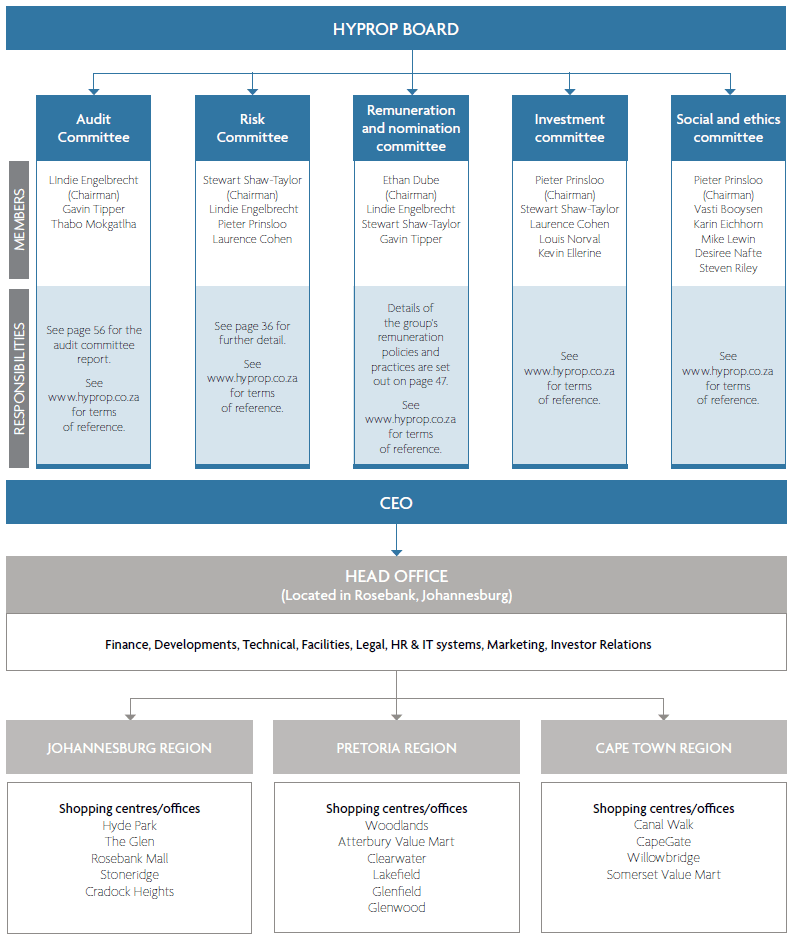
APPROACH TO CORPORATE GOVERNANCE
Our approach to corporate governance is based on a set of values
and principles that underpin the day-to-day activities of the group
which include responsiveness, collaboration, transparency, integrity
and accountability. This approach encompasses a commitment to
excellence in governance standards, which we see as fundamental to
the sustainability of the group’s performance.
application of governance principles
The board is committed to applying the recommendations of
King III and relevant regulation including the JSE rules and regulations,
and complying with legislation such as the Companies Act as well as
relevant standards of best practice. In line with the King III Report’s
‘apply or explain’ approach, the directors will continue to state the
extent to which the company applies these corporate governance
principles to create and sustain value for stakeholders over the
short, medium and long-term, and to explain any instances of non-compliance.
The application of Chapter 2 of King III can be found on
page 102.
ETHICAL LEADERSHIP AND CORPORATE
CITIZENSHIP
Hyprop’s board aims to integrate responsible corporate citizenship
into the company’s growth strategy and daily operations in order to
ensure the company's sustainability. In accordance with the board
charter, the board is the guardian of the values and ethics of the
group. The board strives to lead by example and to embody the
values set out in our Code of Conduct and Ethics. As a business
imperative the directors strive to ensure that the company conducts
its business with the utmost integrity towards all its stakeholders.
The Code of Conduct and Ethics (“the Code”)
The Code provides guidance as to ethical conduct in all areas, appropriate policies in respect of the safeguarding of assets and information, and appropriate measures of enforcement.
The primary purpose of the Code is to promote the good conduct of all employees and other representatives of Hyprop to enable the company “to create the most desirable shopping destinations in South Africa which constantly deliver an exceptional and memorable shopping experience”. This is intended to be achieved through:
| • |
service excellence; |
| • |
striving to comply with international best practice; |
| • |
effective delegation; |
| • |
promoting leadership; and |
| • |
utilising best technology and building principles. |
The Code encapsulates Hyprop’s commitment to best practice corporate governance, including timeous, valuable and transparent communication with all stakeholders. In addition it contains guidelines on confidentiality, fair and ethical market competition and sound environmental practices.
In terms of the Code, Hyprop specifically endeavours to:
| • |
promote a policy of zero tolerance for any form of corruption, unethical business practice and/or behaviour that contravenes any law, regulation or the norms of society; |
| • |
avoid any conflicts of interest that may unduly influence or compromise any employee’s ability to act in the company’s best interests; |
| • |
ensure independence from any business organisation or third parties with contractual relationships with Hyprop; |
| • |
refuse gifts, hospitality or other favours from third parties in return for any kind of favour, service or treatment; |
| • |
conduct its business with integrity, mutual respect and professionalism to enhance the company’s reputation; |
| • |
steer away from direct and indirect discriminatory practices; |
| • |
implement legitimate dealings in Hyprop’s combined units in compliance with South African Securities Services Act (No. 36 of 2004) and the Listings Requirements of the JSE ; |
| • |
apply best-practice corporate governance; |
| • |
protect confidentiality of information; |
| • |
uphold fair and ethical competition in the marketplace in accordance with the relevant competition laws; |
| • |
support the process of sustainable and real transformation; |
| • |
safeguard the use of the company’s assets for legitimate purposes only; |
| • |
implement an effective system of internal control in order to meet the company’s strategic objectives; and |
| • |
subscribe to sound health, safety and environmental practices. |
The social and ethics committee, a committee of the board,
monitors compliance with Hyprop's Code of Conduct and Ethics
and other relevant social, ethical and legal requirements as well as
best practice, and ensures Hyprop is meeting its responsibility to
its various stakeholders. This includes social transformation in the
workplace, and the safety, health and dignity of all employees. The
committee reports to unitholders on matters that fall within the
scope of its mandate at the annual general meeting of the company
and by contributing to this integrated report.
Hyprop further monitors ethical behaviour through the Hyprop
Ethics Line, an independent ethics hotline operated by KPMG. KPMG
provides Hyprop with a regular analysis of calls received to enable
the company to investigate all allegations timeously. Formal reports
of matters which may impact financial reporting are submitted to
the audit committee. Only two reports were received during the
period, which have been addressed adequately.
BOARD AND DIRECTORs
Role and function of the board
The board is governed by a formal charter supported by relevant
authority limits. The board is governed by a formal charter supported by relevant authority limits. The charter and complete terms of reference of the board are available here .
The directors embrace the principles set out by King III, and acknowledge that:
| • |
the board should act in the best interests of Hyprop; |
| • |
the board is the custodian of corporate governance and undertakes to provide leadership based on an ethical foundation, as well as ensuring that ethics are managed effectively; |
| • |
Hyprop is, and should be seen to be, a responsible corporate citizen; |
| • |
strategy, risk, performance and sustainability are inseparable; |
| • |
Hyprop must have an effective and independent audit committee; |
| • |
the board is responsible for the governance of risk (including information technology risk), as well as for determining the group’s levels of risk tolerance; |
| • |
the board should ensure that risk monitoring is a continual process and that risk assessments are performed on an ongoing basis with appropriate risk responses, notwithstanding that management is responsible for implementing the risk management plan and providing assurance to the board in this regard; and |
| • |
the board should ensure that the risk frameworks are such that they increase the probability of anticipating unpredictable risks and that appropriate risk disclosure is made to stakeholders. |
In respect of compliance
| • |
the board must ensure compliance with applicable laws and ensure that compliance risk is addressed in the risk management process, notwithstanding that management is responsible for the implementation of effective compliance and processes; |
| • |
each individual director must undertake to maintain a working understanding of the laws, rules, codes and standards applicable to Hyprop; and |
| • |
the audit committee must receive regular compliance updates from underlying operations and report back to the board on those. |
In respect of the internal audit
| • |
the outsourced internal audit function follows a risk-based approach; |
| • |
the function is overseen by the audit committee; and |
| • |
the function provides regular updates on the outcome of internal audits undertaken. |
In respect of stakeholder engagement, the board should
| • |
give due consideration to the effect of stakeholder perceptions on Hyprop’s reputation and strive to achieve a balance between the various stakeholder groupings in its decision-making processes; |
| • |
give appropriate consideration to the format and content of communication with stakeholders, as well as ensuring that dispute resolution is an effective process; |
| • |
ensure that every effort be made to ensure equitable treatment of stakeholders; |
| • |
ensure that updates on stakeholder engagement are tabled at the social and ethics committee meetings; and |
| • |
ensure the integrity of the integrated report which should include financial and sustainability performance reporting. |
The overarching objective is to ensure that the group delivers
sustainable returns for our stakeholders. The board takes overall
responsibility for directing the company towards the achievement
of its strategic objectives, vision and mission, and for the group’s
integrated performance. This encompasses financial performance as
well as all considerations of responsible corporate citizenship.
Composition of the board
Subsequent to year-end, Hyprop’s board comprises eleven directors,
five of whom are independent non-executives, four of whom are
non-executive, and two of whom are executive directors.
The non-executive directors have diverse backgrounds in
commerce and industry. Their collective experience enables them
to provide sound, objective judgement in decision-making. They
review and ratify Hyprop’s strategy, in addition to monitoring the
group’s performance and that of executive management against
key performance indicators. Specifically they provide opinion and
advice regarding the group’s financial, audit, governance and risk
management controls. In order to ensure sustainable leadership they
also review transformation and succession planning at senior levels
and provide input into the remuneration process.
All directors exercise unfettered discretion in the fulfilment of their
duties, resulting in constructive debate at meetings that continues to
yield well-considered decisions.
The position of Chairman is currently held by an independent
non-executive director, Gavin Tipper, whose role is clearly defined
and separated from that of the CEO, Pieter Prinsloo. Likewise, the
responsibilities of CEO and Financial Director are strictly separated
from those of the non-executive directors to ensure that no single
director can exercise unilateral decision-making. The Chairman
provides leadership and guidance to the board and encourages
proper deliberation on all matters requiring directors’ attention,
while obtaining input from other directors. The CEO and Financial
Director are responsible for implementing strategy and operational
decisions.
The independent and other non-executive directors are not involved
in the daily operations of the company.
Changes to the board
During the period Chairman Michael Aitken retired, independent
non-executive director Jabulane Mabuza and non-executive director
Mark Wainer resigned, with effect from 27 June 2013.
Independent non-executive director Les Weil passed away on
28 June 2013. Over the last decade, Les made a vital contribution to
the success of Hyprop and he will be sorely missed. A tribute to Les
can be found on page 28 of the report.
On 28 August 2013, Thabo Mokgatlha was appointed to the board
of Hyprop as an independent non-executive director. He was also
appointed to the audit committee. Thabo is a Chartered Accountant
(SA) and began his career as a senior lecturer - accounting and
taxation at the University of the North West. He has subsequently
worked as finance manager of the North West Parks Board, centre
manager in the Rustenburg office of the auditor general and finance
manager of Royal Bafokeng Administration (RBA). Thabo is a director
on the boards of a number of listed companies.
Directors standing for re-election at the upcoming annual general
meeting are Ethan Dube, Lindie Engelbrecht, Mike Lewin and Pieter
Prinsloo.
Board appointment process
The board, supported by the remuneration and nomination
committee, is responsible for new appointments. Identification and
selection of candidates is conducted in a formal and transparent
manner. The board and committee take into account the necessary
blend of skills and experience required to drive the company’s
operational progress and sustainable transformation, with specific
relevant factors taken into consideration including diversity and
regulatory compliance.
An induction process is in place which includes, amongst other
things, a briefing by the Chairman, CEO, Financial Director and the
company’s sponsor, Java Capital. New appointees are also introduced
to key senior management at company and shopping centre levels
and site visits to the shopping centres are facilitated.
The appointment of new directors is confirmed by combined
unitholders at the first annual general meeting following their
appointment, in terms of the MOI.
Rotation of directors
The company’s MOI provides for one-third of the non-executive
directors to retire by rotation after a three-year term of office. Being
eligible, the directors in question will offer themselves for re-election
in accordance with the company’s MOI.
Interim appointees retire at the next annual general meeting, when
they may make themselves available for re-election. As appropriate,
the board, through the remuneration and nomination committee,
proposes their re-election to the unitholders. There is no limit on
the number of times a non-executive director may seek re-election.
Succession planning
It is the responsibility of the remuneration and nomination
committee to ensure adequate succession planning for all board
directors, as well as to ensure that all committees are appropriately
constituted and chaired. The committee gives due consideration to
succession planning on an ongoing basis. The board is comfortable
that the depth of skill meets current board succession requirements.
Director development
To the extent necessary directors have access to experts and
other parties in carrying out their duties. In addition, directors are
encouraged to undergo continuing professional development in
their personal capacity.
Company secretary
The company secretary, Probity Business Services Proprietary
Limited, is an independent company secretarial practice providing
services to numerous JSE-listed companies. The board is satisfied
the company secretary, and in particular its representative Neville
Toerien, maintains an arms-length relationship with the board at all
times and is sufficiently qualified and skilled to act in accordance
with, and update directors in terms of the recommendations of the
King III Report and other relevant regulations and legislation.
The role and functions of the company secretary include:
| • |
providing the directors, collectively and individually, with guidance in respect of their duties, responsibilities and powers; |
| • |
providing information on laws, legislation, regulations and matters of ethics and good corporate governance relevant to the company; |
| • |
making directors aware of any law or regulations relevant to the company; |
| • |
properly recording the minutes of meetings, inter alia, meeting attendance registers, resolutions, director’s declarations of personal and financial interest/s and all notice and circulars issued by the company; |
| • |
preparing the notice of the annual general meeting; and |
| • |
assuming responsibility for filing the annual and other returns in terms of the Companies Act. |
It is further the responsibility of the company secretary to keep the board updated in regard of ethics, governance and regulations. The board then reviews any changes and appropriate measures are implemented to comply with best practice in such a way as to support sustainable performance.
Performance self-assessment
An evaluation of the board and individual directors was performed
in 2012 and an evaluation of the sub-committees is scheduled for
October 2013.
The board is satisfied that all of the independent non-executive
directors meet the criteria of King III.
Access to information
Access to the advice and services of the company secretary and
to company records, information, documents and property is
unrestricted. Non-executive directors have unfettered access to
the external and internal auditors, and to management, at any time.
All directors are entitled, at Hyprop’s expense, to seek independent
professional advice on any matters concerning the affairs of the
company.
Access to the board
Unitholders are able to provide recommendations or direction to
the board at the annual general meeting, one-on-one meetings,
investor presentations and through semi-annual investor polls.
Dealing in securities
The board complies with the requirements of the JSE regarding
restrictions on the trading of Hyprop’s units by directors, the
company secretary and employees during the defined closed
periods. In terms of the Code of Ethics and Conduct directors are
required to declare to the Chairman and company secretary their
unitholdings, additional directorships and any potential conflicts of
interest. In conjunction with the Financial Director and sponsor, they
ensure that any required disclosure in respect of trades in Hyprop
units is published on SENS. Directors and senior employees with
access to the company’s financial results and other price sensitive
information are barred from dealing in Hyprop’s units for specified
time periods preceding relevant announcements. A notification
is sent to all directors and affected staff alerting them that the
company is entering a closed period.
Board committees
Please see the outline of board committees on page 32.
The board is satisfied that all committees have fulfilled their
responsibilities during the year. Each committee operates under an
approved charter which is reviewed on an annual basis.
The need for additional committees is evaluated on a regular basis.
Hyprop's remuneration and nomination committees are combined.
Discussions pertaining to agenda items related to nomination
committee matters are chaired by the Chairman of the board, Gavin
Tipper.
There is transparency and full disclosure from board committees to
the board. Committee chairmen provide the board with a verbal
report on recent committee activities and the minutes of committee
meetings are available. In addition, the Chairman of the board and
Chairman of the audit committee attend the company’s annual
general meetings, to answer any questions from stakeholders.
Board meetings and attendance
The board meets at least four times a year with ad-hoc meetings
when necessary, to review, amongst other matters, strategy,
planning, financial performance, resources, operations, risk, capital
expenditure, reporting and compliance matters, standards of
conduct, transformation, diversity, employment equity, human
resources and environmental management.
Relevant information is supplied timeously in advance of meetings,
ensuring that directors can make well-researched and reasoned
decisions.
Details of directors’ attendance at board and committee meetings for the period 1 January 2013 to 30 June 2013 are set out below. Given the six
month period of review, two board meetings were held during this period:
| Directors |
Years of service |
|
Board
meetings |
|
Audit
committee |
|
Risk
committee |
|
Remuneration
and nomination
committee * |
|
Social and
ethics
committee |
|
MS Aitken b (Chairman)
(retired 27 June 2013) |
13 |
|
2 (2) |
|
|
|
|
|
|
|
|
|
| PG Prinsloo (CEO) g |
10 |
|
2 (2) |
|
2 (2) c |
|
1 (1) |
|
1 (1) c |
|
1 (1) |
|
| LR Cohen (Financial Director) |
10 |
|
2 (2) |
|
2 (2) c |
|
1 (1) |
|
1 (1) c |
|
|
|
| EG Dube b f |
7 |
|
2 (2) |
|
|
|
|
|
0 (1) |
|
|
|
| KM Ellerine a |
4 |
|
2 (2) |
|
|
|
|
|
|
|
|
|
| L Engelbrecht b d |
2 |
|
2 (2) |
|
2 (2) |
|
1 (1) |
|
1 (1) |
|
|
|
| MJ Lewin a |
3 |
|
2 (2) |
|
|
|
|
|
|
|
1 (1) |
|
| JA Mabuza (resigned 27 June 2013) b |
|
|
0 (2) |
|
|
|
|
|
|
|
|
|
| L Norval a |
2 |
|
2 (2) |
|
|
|
|
|
|
|
|
|
| S Shaw-Taylor a e |
13 |
|
2 (2) |
|
|
|
1 (1) |
|
0 (1) |
|
|
|
| GR Tipper (Chairman) b |
1 |
|
2 (2) |
|
2 (2) |
|
|
|
1 (1) |
|
|
|
| LLS van der Watt b |
2 |
|
2 (2) |
|
|
|
|
|
|
|
|
|
| M Wainer a (resigned 27 June 2013) |
11 |
|
2 (2) |
|
|
|
|
|
1 (1) |
|
|
|
LI Weil b (deceased 28 June 2013) |
10 |
|
1 (2) |
|
2 (2) |
|
|
|
|
|
|
|
| Executives |
|
|
|
|
|
|
|
|
|
|
|
|
| V Booysen (Financial Manager) |
4 |
|
|
|
1 (2) c |
|
1 (1) c |
|
|
|
1 (1) |
|
| M de Klerk |
2 |
|
|
|
|
|
1 (1) c |
|
|
|
|
|
| K Eichhorn |
13 |
|
|
|
|
|
1 (1) c |
|
|
|
1 (1) |
|
| N Greenstone |
10 |
|
|
|
|
|
1 (1) c |
|
|
|
|
|
| M Hattingh (Financial Manager) |
2 |
|
|
|
2 (2) c |
|
1 (1) c |
|
|
|
|
|
| D Nafte |
2 |
|
|
|
|
|
1 (1) c |
|
|
|
1 (1) |
|
| S Riley |
3 |
|
|
|
|
|
1 (1) c |
|
|
|
1 (1) |
|
| Y van der Merwe |
2 |
|
|
|
|
|
1 (1) c |
|
|
|
|
|
a Non-executive
b Independent non-executive
c By invitation
d Chairman audit committee
e Chairman risk committee
f Chairman remuneration and nomination committee
g Chairman social and ethics committee
* Now combined into one committee
Remuneration of directors and senior executives
The remuneration paid to directors during the period, together
with information relating to the direct and indirect holdings of the
directors at 30 June 2013 and their participation in share incentive
schemes (where relevant), is disclosed in of the financial
statements.
Compliance with laws, rules, codes and standards
The National Legal Executive, Desiree Nafte, together with executive
management, ensure that the company complies with all current
regulations and legislation. In doing so they liaise closely with the
company’s sponsor. Areas of non-compliance are formally tabled
through the risk management process under the supervision of the
risk committee.
No areas of non-compliance have been identified. H yprop is
familiar with the Property Sector Charter and has established a
subcommittee of the board to monitor progress against the charter,
with particular focus on transformation.
Acts with which the company is required to comply include the following:
| • |
Property Sector Charter; |
| • |
Basic Conditions of Employment Act, 75 of 1997; |
| • |
Companies’ Act, 71 of 2008; |
| • |
Compensation for Occupational Injuries and Disease Act, 130 of 1993; |
| • |
Competition Act, 89 of 1998; |
| • |
Employment Equity Act, 55 of 1998; |
| • |
Labour Relations Act, 66 of 1995; |
| • |
Occupational Health and Safety Act, 85 of 1993; |
| • |
Value Added Tax Act, 89 of 1991; |
| • |
Financial Intelligence Centre Act, 38 of 2001; |
| • |
Consumer Protection Act, 68 of 2008; |
| • |
Safety at Sports and Recreational Events Act, 2 of 2010; |
| • |
South African Securities Services Act, 36 of 2004; |
| • |
Income Tax Act, 58 of 1962; and |
| • |
Promotion of Access to Information Act, 2 of 2000. |
As Hyprop is a listed REIT, the company is required to comply with
the JSE Listings Requirements, including rules that are specific to REITs
in South Africa.
Anti-competitive behaviour
Hyprop has not been party to any legal actions for anti-competitive
behaviour or monopoly practices during the period.
Information technology
The board recognises IT governance as an integral part of the
company’s holistic approach to governance. It is management's
responsibility to effectively manage relevant IT risks with oversight
from the risk committee. During the prior year an internal IT audit
was conducted and all systems and operations were deemed sound
and sufficient for the purposes of the business.
Hyprop is in the process of reviewing its IT structures to increase
operational efficiency and establish standardised policies and
procedures for effective IT governance. The review will be
completed within the next financial year. The group’s database has
been restructured and a single property management system has
been implemented across the company.
Hyprop's aims for the year ahead include the formulation of a formal
IT governance policy and charter, and implementing an IT internal
control framework.
|

